





1. Voices Without a Common Origin
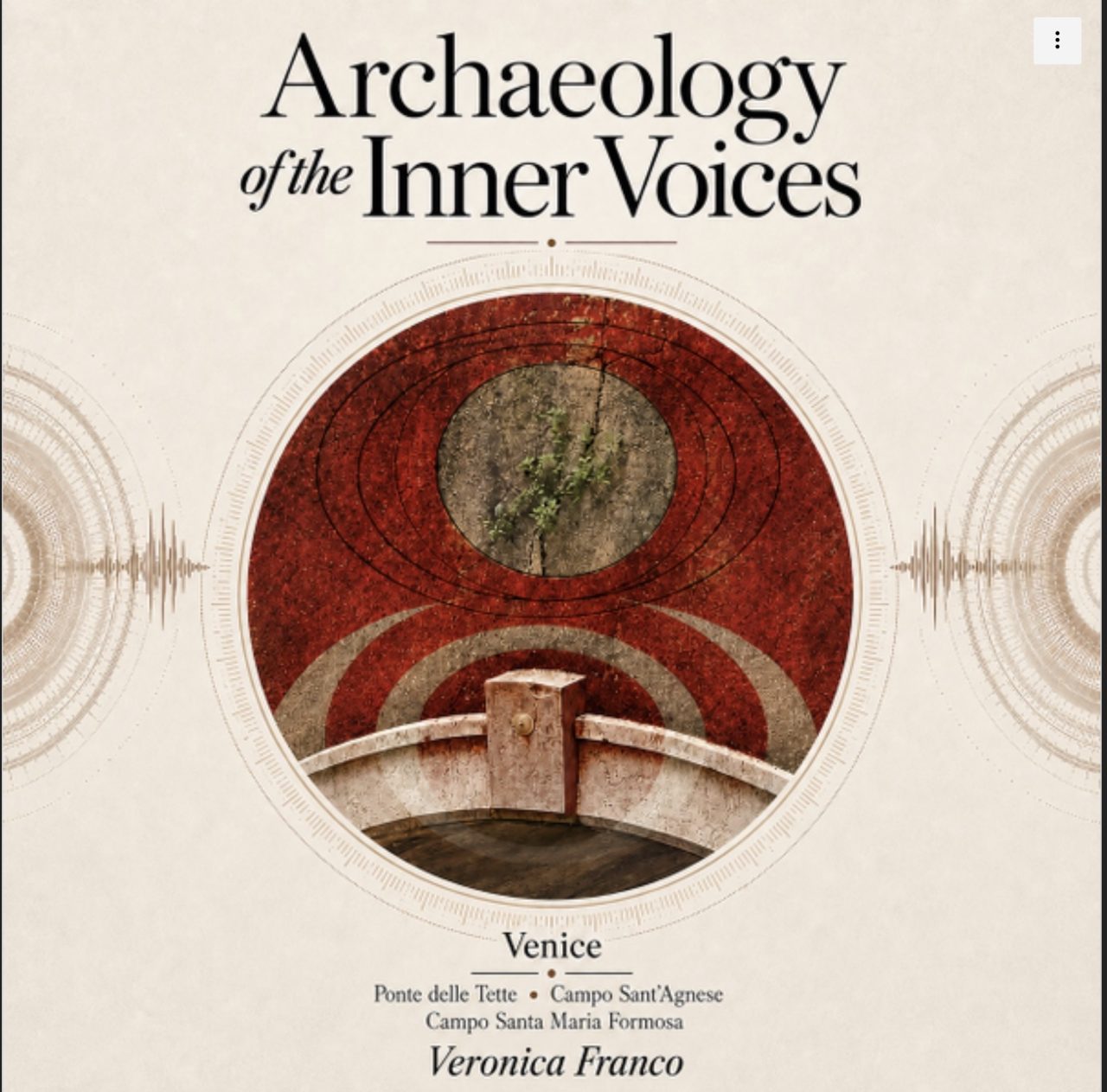
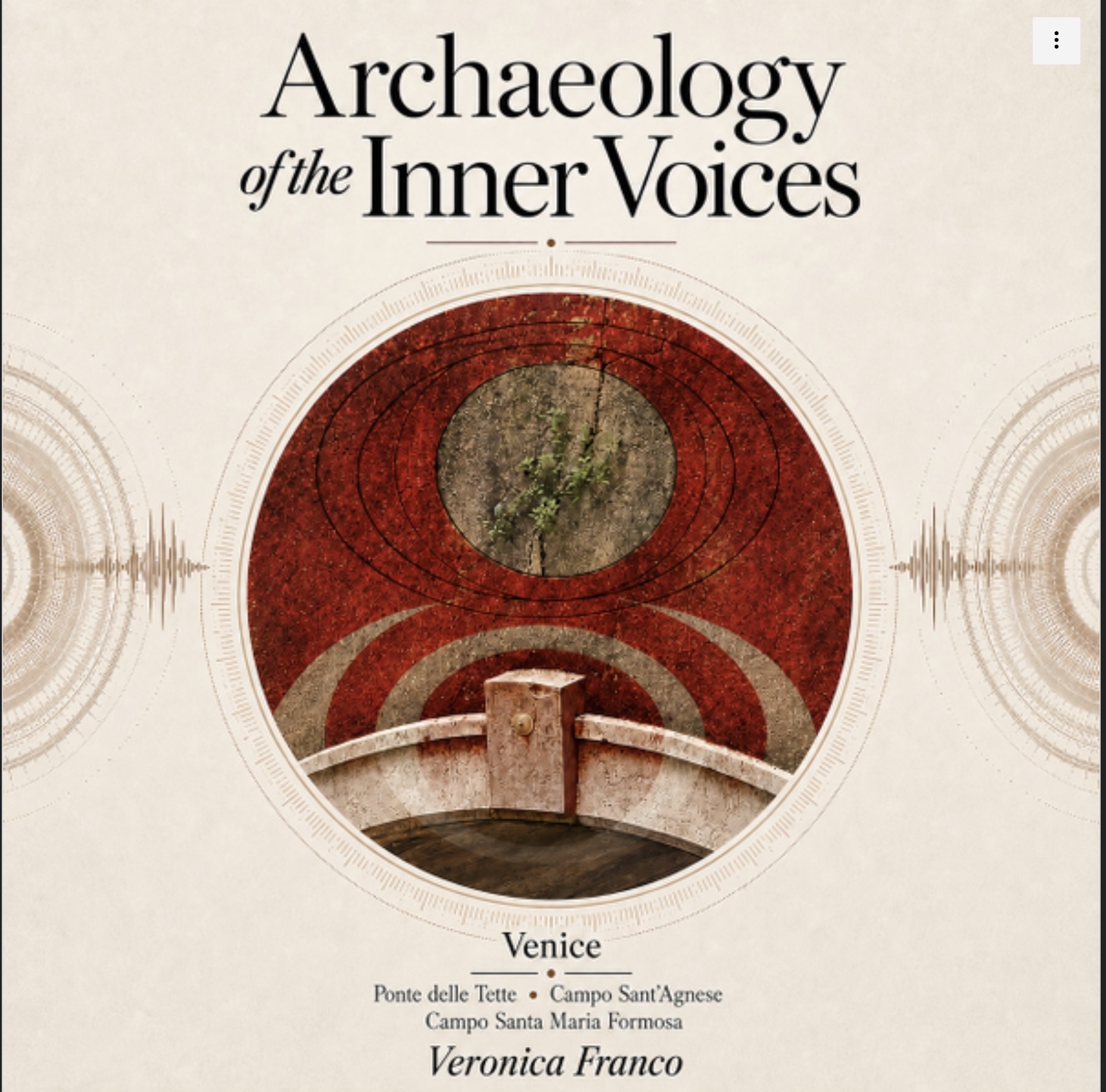
When I enter the radius of any of the three geolocations—Campo Santa Maria Formosa, Ponte delle Tette, or Campo Sant’Agnese—verses by Veronica Franco become audible through the headphones. They are read by a synthesized voice. The text is intelligible, the delivery fluid and close to the ear. No recording of her voice exists, nor has one ever existed. The words have an identifiable author, yet their sonic presence occurs only now, in the device I carry with me. Each of these places is connected to Veronica Franco differently: Campo Sant’Agnese through parish and family records, Campo Santa Maria Formosa through her public and literary presence, and Ponte delle Tette only indirectly, through the broader regime governing the visibility of the female body and the historical position of the cortigiane oneste. The same voice appears where her name is inscribed and where her name is nowhere to be found. What audibly changes from one site to another is the acoustics: a narrow stone passage, the water beside a bridge, and an open square return the same voice in three different ways.
This is the most recent configuration of a work that has been developing since 2017. Alongside the recital, different material runs on the other channel. Letters, syllables, breaths, and interruptions approach words, at times almost a sentence. A few repetitions are enough for me to hear intention. Then the nearly formed phrase disperses back into voice. Here too I have the sense that someone is speaking, yet both the speaking position and the meaning recede. This stream comes from no text. It emerged from the sound of the city itself. Both voices mingle with recorded Venetian ambience captured at these same sites. Water, footsteps, boats, echoes between façades. The recording returns to the place where it was made and encounters a site that now sounds different. A recorded footstep coincides with an actual one. A voice in the headphones interweaves with a passer-by’s conversation. For a few moments, the rhythm of a present-day boat continues a rhythm that began in the recording. As I listened to these layers together, I became less interested in the question of how to situate a historical text in space. What increasingly occupied me was the relation between the two vocal streams. On one side, words with a clear authorial provenance and a voice that never belonged to their author’s body. On the other, a vocal presence without a text. The first stream has meaning but no historical voice. The second has a voice, while meaning refuses to close. Today they belong to the same composition, although conceptually they emerged from different periods of my practice.
To understand why a stream of letters and near-words is present alongside Veronica Franco’s poetry at all, I have to go considerably further back. Its origin lies neither in Venice nor in literature. It began with an experiment in which I tried to produce a sign-based organization from ambient sound without a message preceding it. Each subsequent performance answered something that the previous one had not yet been able to ask—and it is this displacement that I am trying to trace here.


2. Before Meaning
One early realization of this procedure was a performance titled Demorsing, presented within Share.NYC in Brooklyn. At that point I was not yet using a literary archive, nor had I come to understand the inner voice as a central question in my work. I was working with recording, transmission, and inverse sound processing, observing what each technical operation did to captured ambient material. The title Demorsing refers precisely to this inversion of the usual logic of Morse code. Morse code begins with a formed message and converts it into a coded sonic system. I began with the reverse process: a field recording in which rhythms, interruptions, and intensities passed through a Morse matrix and became alphabetic or sign-based structures. There was no sentence behind them that could ultimately be reassembled.
For the Brooklyn performance, I recorded sound at various sites in New York that I associated with histories of European immigration and labor, among them Grand Central Terminal, the Central Railroad of New Jersey Terminal, and the exhibition spaces of the American Museum of Natural History and the Metropolitan Museum of Art, where objects from non-European cultures are present through histories of colonial appropriation and displacement. I was interested in a relatively circumscribed formal problem: displacement preserved the object while stripping away the relations within which its meaning had been formed. In the case of a person, linguistic and social relations are rearranged, while the speaking position remains with them. The loss is different for an object. In the environment from which it came, it was not primarily something to be seen—it participated: in use, ritual, exchange, labor. At the time, I understood museum display as a procedure that transforms a participant into an object of viewing, recasting it as a curiosity or an aesthetic achievement. A person displaced from one context loses the context of their speech; an object loses the possibility of participation.
While recording in these galleries, some objects held my attention longer than others, and I responded to this without being able to say exactly what I was responding to. The differences between later performances gradually clarified the issue: it was not simply a loss of context, but a question of when something still counts as a participant in an event and when it becomes merely a bearer of meaning assigned by someone else.
In the Brooklyn performance I spoke the letter structures that the demorsing process generated from the field recordings, lending my voice to the sign organization that had emerged. The speaker of the code was therefore the performer himself. What I spoke was an articulation that followed a structure produced by the ambient event and its technical transformation, rather than by a text of my own or any pre-formed content. Something happened here that I had not anticipated in the initial conception. At times the letters happened to connect into fragments resembling simple words. Repetition acquired rhythm. A chance combination raised the expectation of a sentence, then broke off. There was no hidden text in the input material. Even so, a sign organization appeared that was already directing listening towards meaning. At the time I did not yet call this an asemantic poetics. I noticed an intermediate state between sonic event and statement. Something was already behaving like a sign; listening began to attribute to it intention, the possibility of syntax, or the beginning of a word. Only later did I recognize in this a formal affinity with the problem of dislocation that had guided my choice of New York sites. Demorsing made such a gap audible in a fairly elementary form: the sign is present, while its statement remains open.
From that point on, I became interested in who or what fills this open space. If a material or signifying appearance does not itself determine its meaning, where does interpretation come from? The next performance placed this question alongside objects that had no shortage of meaning. Meaning had already accumulated around them.
3. The Attribution of Voice
For a performance at Gallery 42 in Cetinje, I selected sonic material from two locations in Ljubljana associated with monuments to France Prešeren and Petar II Petrović Njegoš. I was interested in the encounter between two nineteenth-century literary figures who later acquired powerful national-symbolic roles, each through a different historical trajectory. Prešeren’s work contributed to establishing Slovene as a language of high literature, while his later canonization placed him at the center of the Slovenian national imaginary. With the independence of the Republic of Slovenia in the 1990s, his poem Zdravljica also acquired direct status as a state symbol. Njegoš was a poet, Orthodox prince-bishop, and political ruler. His work and historical figure subsequently entered Montenegrin, Serbian, and Yugoslav frameworks of identity. I was particularly interested in the position of both figures after the dissolution of Yugoslavia. New political contexts reactivated already consolidated national references. Prešeren’s symbolic position became closely bound to independent Slovenia. Njegoš’s legacy became subject to divergent Montenegrin and Serbian readings, while his epic Gorski vijenac became the subject of curricular disputes in Bosnia and Herzegovina: in the post-war review of school textbooks conducted by the Office of the High Representative, it was included among materials considered for removal from classroom use. [1] The same historical figure could thus appear as a canonical reference, an identity symbol, and an object of rejection.
The status of the voice also changed in the Cetinje realization of Demorsing. Whereas in the Brooklyn version I had spoken the stream of letters myself, in Cetinje it was read by a generated voice which, at that stage of its development, was still distinctly rough and audibly machine-like. The letter structure had no prior message, and the voice did not come from the body of a speaker present in the room.
At the two monuments in Ljubljana, the problem reversed itself for me. In New York, displacement had opened the gap between presence and context: an object removed from the relations that had previously participated in forming its meaning. The statues, however, had not been displaced anywhere. They stand where they are meant to stand, surrounded by every canonical and commemorative support one could ask for. Over time, numerous mutually incompatible statements have formed around them. The gap, then, is not a consequence of displacement. Displacement had merely made it perceptible. I used the recordings in the Cetinje performance, where no material object was present before me—only the sonic trace of two Ljubljana locations, played back several hundred kilometers away. The initial assumption I had made in New York therefore did not hold. Dislocation was not the cause of the gap but the circumstance that first allowed me to perceive it—and I could only discover this by transferring the same procedure elsewhere. Njegoš was already a displaced figure in Ljubljana, and his recording returned to the city that had been his seat. Prešeren’s recording, by contrast, left the center that had canonized him. The same gesture was thus simultaneously a return and an export, while the asymmetry between the two figures was doubled by the asymmetry of my procedure.
How much of what we attribute to a historical figure derives from that figure? How much is spoken through it by the way the present reads it? In this context, I found a historical association with the Colossi of Memnon useful. The so-called Colossi of Memnon are monumental images of Pharaoh Amenhotep III; in the Greco-Roman period, the northern colossus was associated with the mythological Memnon. On certain mornings it produced an unusual sound that visitors understood as Memnon’s voice. The sound was not constant. It appeared only after the statue had been damaged and only on some mornings, when a fissure in the stone, the cold of the night, and the first warmth of the sun coincided. When the statue was later repaired, it fell silent. The voice was therefore an effect of damage and of a recurring conjunction of conditions, not a property of the statue. Yet neither the speaker’s name nor the meaning of the address followed from this configuration of stone, cold, and sunlight. The sound itself did not contain the name “Memnon”. All of this came from the mythological, cultural, and cultic framework through which the phenomenon was heard.
The sound had a material cause; the speaking position arose elsewhere. The mere fact that I cannot see the source of a voice is not enough for me here. What interests me is the moment when a sonic phenomenon is assigned a speaking instance, and with it a position from which the statement is presumed to come. Memnon helped me separate this step from the production of the sound itself. I then encountered a similar question in the monument. Njegoš’s statue does not control the interpretations that different historical moments purport to speak through it. The material presence of the object does not itself determine whether the historical figure will appear as national poet, political ruler, identity symbol, or object of rejection. A mode of reading operates between object and statement. The question I retained from Memnon was not who was speaking, but what has to coincide for a voice to sound at all. In the colossus: fissure, cold, and first warmth. In listening to the text of an absent author: something else, something I cannot fully enumerate.
The asemantic stream does not set an interpretation of its own against ideological readings. Because it states nothing itself, it makes the act of attribution audible—and in doing so deprives each of these readings of its strongest feature: the appearance that the monument speaks for itself.
With Njegoš, this effect was especially pronounced. National canon, competing identity appropriations, and rejection all referred to the same historical figure. The asemantic stream did not adjudicate among them; for a moment, it disturbed the self-evidence with which an interpretation can be attributed to an object and then discussed as though the object itself confirmed it. Here I began to understand asemanticity as a disturbance within a regime of attribution. Its incompletion does not reveal a hidden truth of the monument. It opens a difference between material presence and the discourses that speak through it in the present.
Demorsing brought meaning close and then withdrew it again. How did an intelligible literary recital later enter this arrangement?
4. Between Code and Recital
The asemantic stream produced partial syllables and, occasionally, whole words. I became interested in whether this stream could be compared in real time with digital records. I therefore connected the process to a digitized collection of selected literary texts and introduced an algorithm that searched the emerging letter patterns for matches within the textual corpus. When sufficiently pronounced constellations occurred, it triggered a fragment of already semantically organized text.
The matching was entirely formal. The causal chain is complete and traceable: through sampling and the Morse matrix, an ambient rhythm is converted into partial syllables; these match an entry in the corpus and trigger a recital. Yet nowhere in this chain is there a step that recognizes meaning. The text that is subsequently heard already carries meaning—linguistic, authorial, and historical. This is precisely the asymmetry that later became one of the work’s central characteristics: trigger and triggered belong to two different orders. The stream of letters is not an incomplete form of the literary text, nor is the recital its translation.
The algorithm therefore determines actualization without understanding anything. The match has no semantic necessity—the verse that sounds says nothing about the ambient event—yet it has a consequence: the literary fragment ceases to be a possibility in the corpus and becomes an event in space. The criterion is computational; the effect is semantic. In this gap I see an older and more elementary form of the same logic we now associate with algorithmic culture: a system need not understand a relation in order to make it consequential. My algorithm does not interpret ambient sound or assign content to it. It merely enables an encounter between two regimes that remain distinct: the asemantic stream can continue to oscillate between voice and near-language, while the recital introduces semantically articulated text into the same event.
The literary archive began to change for me as well. It was no longer simply a collection of texts that could be triggered. The relation between a particular text and a place—its history and its sound—became increasingly important. From this emerged the idea of the Emerging Library of Inner Voices: an open corpus of literary and archival texts that acquire a different position and a different vocal presence with each performance.
The two-channel structure developed from this relation. As a rule, the semantic recital occupies one channel, while the asemantic stream and the ambient material occupy the other. On the first, linguistic content stabilizes relatively quickly, while the attribution of the voice remains open: I can identify the author of the text, but the voice that speaks it arises elsewhere and later. Machine intonation, rhythm, and articulation nonetheless produce a pronounced vocal presence. The historical speaker becomes no more present as a result—I hear their absence precisely at the moment of vocal proximity. On the other channel, the situation is almost reversed: vocal organization is strong, while semantic determinacy continually approaches and recedes.
With Veronica Franco, I hear this difference most directly. No recording of her voice exists, nor has one ever existed; what survives historically is a text, not an act of speaking. Synthesis does not transmit the text—it has to produce what the written record does not contain: duration, tempo, points of emphasis, breath between lines, the proximity of a speaker to the ear. All these determinations arise only now, in the device I carry with me. What I receive is the perceptual phenomenon of someone speaking, although no corresponding act of speaking exists in the past. For this reason, the voice is neither a reconstruction nor a forgery. It is a speech event without a historical original.
At this point, the meaning of the term inner voice began to change for me. I increasingly understood it less as a special kind of voice that could simply be distinguished from an external one. More interesting were situations in which the apparently self-evident connection between a voice and its source loosened. My own voice returns from another time. The text of an absent author acquires intimate proximity in listening. A technically produced voice assumes a speaking position without a body to which I can assign it. Interiority thus appears to me above all as a position of listening in which the relation between voice, meaning, and speaker is only assembled in the event.
The inner voice consequently began to appear to me as something that belongs to the listener no more than language does. Language cannot be found anywhere as a whole; it exists only in particular instances of use, it was here before us, and it will remain after us. The inner voice occupies a similar position. I do not possess it as something stored inside me. It sounds when conditions coincide—a text by someone else, a delayed recording, the acoustics of a space, a moment of attention—and then it speaks through me.
The two-channel structure makes this almost physically perceptible. The two vocal streams are technically separate, but their shared perceptual field arises in the listener. On one channel, meaning stabilizes faster than the identity of the voice; on the other, vocal presence takes shape faster than meaning. Much later, I recognized in this division a formal resonance with Jaynes’s idea of bicamerality. His writing was not the starting point for the procedure. What drew me to it was the radical question of how and where a person attributes the source of a voice they hear. The channels in my work remain compositional devices; their shared field emerges only in listening.
Performances in different languages revealed another distinction. The asemantic stream has no neutral sonic character, because the names of letters in speech synthesis are not the same as their sounds. In the Slovenian pronunciation model I used, the stream breaks into short, rough units; in the Italian model, the same sequence of signs links together more fluidly and more often approaches a word. The difference is not merely timbral. Language changes the speed with which an expectation of meaning arises within the stream, and therefore the moment at which the listener begins to attribute intention. Semantic openness at the sonic level is thus not formless—each time, it takes the form of the language through which it is voiced.
What happens when this structure leaves the technical schema and enters places with their own architecture, history, and sound?
5. Fields of Actualization


Cukrarna — The Delay of One’s Own Voice
At Cukrarna, the relation between body, architecture, and system was direct. The metal staircase functions both as a path of movement and as a sounding object. Footsteps excite it, while speech and other sounds made by visitors enter a feedback loop and participate in the formation of letter structures and the triggering of literary material. In the web-streaming configuration, a visitor’s voice could also be captured by chance and return to the listening situation roughly sixteen seconds later. The interval arose from the technical time of streaming. In the space, it manifested differently. In sixteen seconds, the body has already moved. Attention has shifted; the moment of utterance is over. When the voice returns, I still recognize it as my own, yet it is no longer temporally synchronized with the action that produced it. Self-recognition remains. The immediate coincidence of voice and body comes apart. For a moment, the voice becomes a trace of one’s own act and part of the environment through which it returns to the body.
Cukrarna also carries a historical-literary layer that I could not ignore. Within the broader archive of Slovenian modernists encompassed by the recital, Josip Murn Aleksandrov’s Balada stood out. In my reading of the poem, the experience of living in Cukrarna condenses into the motif of knocking on a wall, where the address returns to the speaker almost as a test of their own presence. In the performance, the same experience sounds through footsteps on the staircase. The delayed voice and Murn’s text belong to two entirely different times.
Their difference, however, is not only temporal. The visitor’s delayed voice is the sonic trace of an actual speech event that occurred sixteen seconds earlier. Murn’s recital has no such original: his poem is historical, while the voice comes into being only now.
For a brief moment, the building brings them into acoustic proximity: the visitor’s voice returns through an architecture that already carries an older literary trace of distress, address, and response. Sixteen seconds thus meet the far longer historical temporality of the site.
What happens when a trace belongs to a world that can no longer be directly recalled?


Freud Museum — Trace and Absence
In the museum, I had to place the work under different conditions. I did not perform it live but simulated it technically. The simulation incorporated visitors’ movements, the acoustic characteristics of the rooms, and other perceived events that affected the organization of the recital material. From it I produced a recording, which I transferred into a geolocated sound walk.
The museum itself already works with traces. The rooms are not arranged as a reconstruction of the consulting room; instead, they bear the traces of Freud’s exile: a lighter patch on the wall outlines a removed tapestry, while elsewhere a photograph shows how the room looked when he was still there. The visitor sees what is absent, and no one explains it to them. This is precisely what the simulation lost. At Cukrarna, the visitor’s voice entered the system and returned to them transformed; here, their step through the room with the mark on the wall should have encountered a recital of Freud’s writing on dreams—a visible and audible trace of the same absence in the same moment. The sound walk preserves this relation, but the listener receives it already assembled. The part that would have arisen only from their own presence falls away. It was this loss that taught me something about my own system: interactivity cannot be replaced by a more precise arrangement of material. What I simulated were the conditions; the event arose from someone I could not predict.
The sonic material carried the same relation between what is preserved, what is missing, and what is present: floorboards creaking under visitors’ feet, different rhythms of walking and pausing, the voices of guided tours, and documentary voices, including that of Anna Freud. These sounds do not belong to the same time and do not compose a single narrative. In the technical process, they formed a heterogeneous initial field from which an asemantic structure emerged and then triggered Freud’s recital. It was precisely the incompleteness that proved productive. A single footstep, a documentary voice, or a preserved object remains a trace of something no longer directly present, and connecting it to other fragments does not eliminate that partiality. This also changed my relation to the archive: a fragment enables contact with what is absent while preserving absence as part of the experience. Only later did I recognize in this an affinity with Freud’s own use of archaeological imagery in thinking about psychic traces. That connection came after the performance and helped me understand more precisely why, in the museum, I was drawn more to trace and absence than to reconstruction.


Navje — Overlapping Temporalities
At the Navje memorial park, the relation between topos and ambientality is different again. The former cemetery and present-day memorial park form a compact island of vegetation within an intensely urbanized city. Bird calls and seasonal rhythms interweave with rail and road traffic, mechanical sounds, and other urban events that enter the space from its edges. Within this relation, an association opens onto Ivan Grohar, who is buried at Navje. His return to his home environment and his later attachment to a rural landscape depleted by emigration establish an almost parallel situation in relation to present-day Navje: the green fragment barely holds its ground, resisting the intensity of the city that later development has brought up to and around it. Natural and urban sounds therefore form more than an acoustic contrast; at the site of his grave, they actualize a tension between the rural environment with which I associate him and an urban dynamic that has symbolically and sonically reached him again. This relation is audible. Birdsong and seasonal rhythms are still present, but they do not determine the sound field. Rail traffic and road traffic enter from the edges and can cover them at any moment. The geolocated recording adds a shorter temporal difference to this long transformation. The recording remains the same; the current ambience changes. A recorded bird call may coincide with an actual bird, a train may cover it, a traffic rhythm may continue something that began in the recording. The relation between the two did not yet exist at the time of recording. It arises in listening. Here, two temporalities overlapped with particular clarity for the first time: the slow transformation of the relation between rural and urban, and the short interval between the recorded and current sonic state of the same place.
After experiencing the geolocated sound walk that follows the path through the Navje memorial park, I was able to return to Venice differently.
Venice — Non-Homogeneous Actualization
At first, I was drawn to the unevenness of the three geolocations. I now began to understand it as part of the composition itself. I associated Campo Sant’Agnese with a family or parish trace of Veronica Franco. Campo Santa Maria Formosa opens onto her broader public, social, and literary presence. Ponte delle Tette has a more indirect connection to her, and I approached it through the broader historical regime of prostitution, regulation, and the visibility of the female body. The three historical connections carry different weight in her biography, but they do not affect the selection or arrangement of the literary material.
Rather than the historical relations, I focused on acoustic diversity. A canal, a narrow stone passage, and an open square create different conditions of listening. Water and boats produce mobile rhythms, stone façades return footsteps and voices, and the sound field opens out in the squares. Acoustic heterogeneity acts upon the sonic presence; historical heterogeneity acts upon what the same voice can be heard as. The technical output remains the same; what changes is what can be attributed to it at each site. The recorded ambience, too, encounters a different current state of the same spaces each time it is heard again.
The same water that produces these rhythms also operates within a time that has nothing to do with either Veronica Franco or my recording: the lagoon, the tides, the subsidence of the city. The range of the Venetian sites therefore extends not only back to the sixteenth century but also into a time in which there is no speaker and no statement that could be attributed to anyone.
6. Archaeology of the Stratified Field
I began to look for an answer in the differences between performances.
Part of the procedure returned, while the conditions changed. It was precisely this partial continuity that allowed me to notice what each new situation shifted. Repetition gradually acquired a differential function. Cetinje showed that the gap between presence and statement was not a consequence of displacement: the monuments had not been displaced at all, yet they did not determine what spoke through them—displacement in New York had merely made the gap perceptible. Cukrarna opened the relation between the temporal dislocation of one’s own voice, the body, and architecture. The Freud Museum separated the trace from the demand to reconstruct an absent whole. At Navje, once the recording returned to the same place it began to produce relations that had not existed when it was made, while a short sonic difference encountered the long transformation of urbanization. In Venice, the non-homogeneity of historical and acoustic structure entered the composition itself.
No performance simply confirms the previous one. With each displacement, the same or related elements acquire a different experiential status. What I first understood as a technical effect appears elsewhere as a temporal problem. From this comparison emerged the concept of the stratified field.
I do not imagine the stratified field as a repository of ready-made layers. A trace does not have the same status everywhere. Cukrarna does not “contain” Murn in the same way that it contains the metal staircase. Venice does not contain Veronica Franco as a material datum. This is what I mean by topos. Not a location as a container of history, but a local configuration of different modes of presence—material, architectural, textual, symbolic—in which the same technical operation acquires a different status. At the Njegoš monument, the displacement of the recording was a return; at the Prešeren monument, an export. At Campo Santa Maria Formosa, the same synthesized voice can more readily be heard as the voice of a historical figure; at Ponte delle Tette, it becomes more evident that the relation has been established by the present-day work. The algorithm has not changed. What has changed is what can be attributed.
Text, historical trace, architecture, current sound, and technical procedure occupy different positions within such a field; for a limited time, the performance establishes an operational relation among them. Latency changes as well. An element that is barely noticeable in one situation may become decisive in another. What changes is the manner in which it enters the whole. I began to notice this most clearly in relation to time. Sixteen seconds at Cukrarna, the difference between recorded and current ambience at Navje, and Veronica Franco’s distance of several centuries are not different quantities of the same past. They are temporally heterogeneous positions brought into relation with the present in a concrete act of listening.
For this range, I use the term temporal amplitude of a location. Amplitude designates the span between temporally distinct layers that a performance brings into proximity while allowing their differences to remain audible. Sixteen seconds and several centuries can appear within the same moment of listening as two entirely different forms of temporal distance.
This understanding also changed my relation to history. I cannot directly recall a past event, yet its effects remain dispersed across architecture, text, object, name, commemorative habit, the use of a space, or conflicts of interpretation. A performance can make one of these traces more pronounced for a time and thereby alter the perception of the present as well. The present thus appears to me as the most exposed cross-section of a broader temporal field at a given moment. Some connections are directly perceptible; others remain weak or latent. Yet I do not make this cross-section myself. The field does not wait for me to enter it through listening; I am already standing within it, and my present is itself one of its cross-sections. I can therefore never hear it from outside, nor hear it in its entirety. Each act of listening is a local manifestation of the field, not a view onto it.
It was here, too, that the term archaeology became more precise for me. The word comes with its own theoretical history; I use it in a limited sense, to describe work with partial traces and their actualizations, not as the adoption of an already constituted archaeological method. What is at stake is partial access: a given performance makes some relations discernible, while others remain beyond its reach. I was able to recognize the research logic of my own work largely in retrospect. The Brooklyn situation did not yet contain a theory of the inner voice. Cetinje was not a plan for Cukrarna, the Freud Museum, Navje, or Venice. Each performance opened a problem that shifted in the next. Demorsing was first a technical experiment, then a problem of semantic indeterminacy, and, beside the monument, a disturbance in attribution.
Theoretical literature occupied a similar position. It entered my work later, when I was looking for a more precise language or a historical interlocutor for problems that had already opened through practice. Jaynes’s bicamerality offered me another way of looking at the attribution of a voice’s source; Freud’s archaeological metaphors retrospectively illuminated the experience of trace and absence in his museum. Theory did not initiate the work here; it sharpened it after the fact. Literary texts have a different function. Murn, Freud, and Veronica Franco are materials that enter technical, spatial, and historical situations. Their texts already carry linguistic and historical organization. Performance alters the conditions of their vocal presence and the way they encounter the present.
This is also where the question of knowledge opens for me. Before Cukrarna, I did not have a formulated thesis about a sixteen-second temporal fissure for the installation to demonstrate. Before Cetinje, I did not know that the semantic indeterminacy of Demorsing would begin to function beside a monument as a disturbance in attribution. The relations among the recording, urbanization, and current ambience at Navje did not yet exist when the recording was made. Repeating the procedure at different topoi did not test the same result. It showed what belonged to the procedure and what arose only within a specific configuration—and that distinction could not have been made except through performance. A performance often changed the question with which I entered it; the next configuration then opened something I could not yet have formulated precisely enough before the previous one.
These questions—the distributed speaker, a formal relation without understanding, synthetic vocal presence—entered my work almost a decade before the current generative conjuncture. Today they have become more broadly recognizable and are returning in a different technological configuration.
If I listen to the Venetian iteration again at the end, I hear more than two channels and three geolocations. I hear the different temporal layers in the development of the research: the early Demorsing, the Cetinje question of attribution, the algorithmic connection to the literary archive, the experiences of Cukrarna, the Freud Museum, and Navje, and the current sonic state of Venice. It is precisely this simultaneous presence of layers at different temporal distances that I did not yet know how to name at the outset of the research. Archaeology of the Inner Voice emerged as a title only once it became possible to recognize that each performance opens only a particular cross-section of a wider field—and that research insight takes shape through the differences between these cross-sections. In Venice, the same voice sounded differently at each of the three sites; the next location will alter it again, and for a moment it will be impossible to say which time is sounding through it.
Notes
1) See Andrew B. Wachtel, “How to Use a Classic: Petar Petrović Njegoš in the Twentieth Century,” in J. Lampe and M. Mazower (eds.), Ideologies and National Identities (Budapest: CEU Press, 2004), pp. 131–153. [back]
Comments are closed